
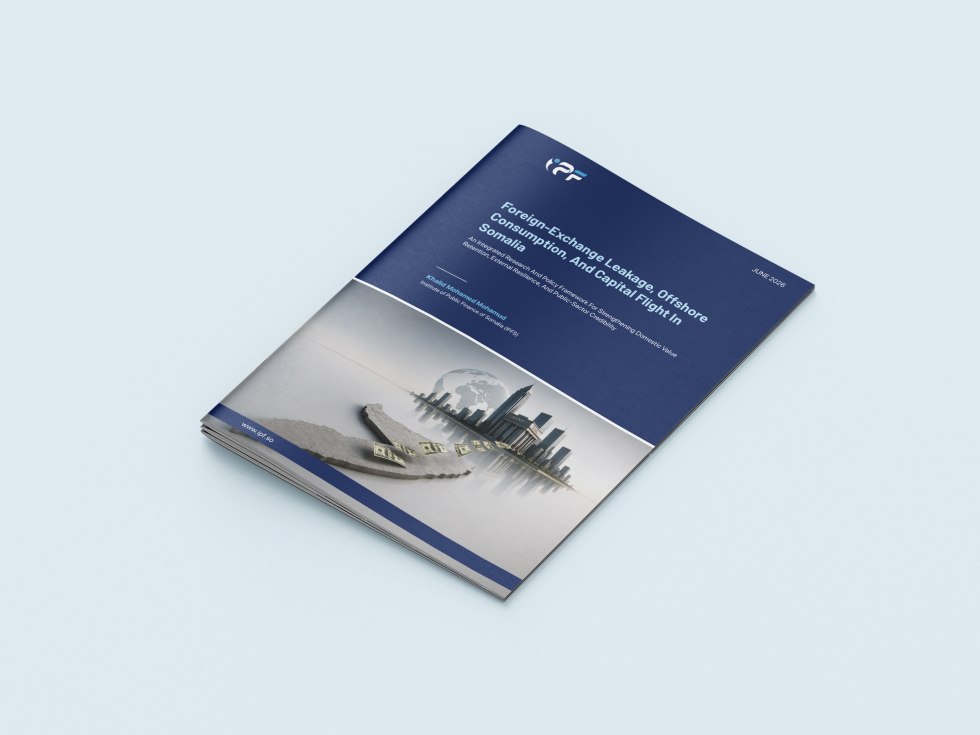
Foreign-Exchange Leakage, Offshore Consumption, and Capital Flight in Somalia
June 24, 2024·Khalid Mohamed Mohamud
Core Thesis
The paper argues that Somalia’s economic fragility is fundamentally a “domestic value-retention problem.”
A large share of income generated inside the country is continuously spent abroad on imports, services, and external assets, creating persistent foreign-exchange (FX) leakage.
Key Concepts
Foreign-Exchange Leakage
Foreign-exchange leakage refers to the outflow of foreign currency caused by:
- Imports of goods.
- Payments for foreign services.
- Offshore consumption.
- Capital flight risks.
Offshore Consumption
Offshore consumption refers to legitimate spending abroad by households and firms, including:
- Education.
- Healthcare.
- Travel.
- Business services.
Capital Flight Risk
Capital flight refers to possible illicit or unrecorded outflows, such as:
- Trade misinvoicing.
- Hidden foreign asset accumulation.
- Corruption-related transfers.
The paper emphasizes measurement discipline, distinguishing between:
- Recorded financial flows.
- Observable economic indicators.
- Unobserved risks.
Empirical Findings (2024 Data)
1. Trade Imbalance: The Main Leakage Source
Trade data highlights significant dependence on foreign goods:
- Imports: $9.18 billion.
- Exports: $1.56 billion.
- Trade deficit: $7.62 billion.
- Export coverage: 17%, meaning exports finance less than one-fifth of imports.
This indicates extreme dependence on imported goods and services.
2. Services Deficit: Offshore Consumption
The services sector also contributes to foreign-exchange leakage:
- Service credits: $1.34 billion.
- Service debits: $2.32 billion.
- Net services deficit: Approximately $0.98 billion.
This reflects spending abroad on:
- Healthcare.
- Education.
- Logistics.
- Travel.
3. Total Recorded FX Leakage
The combined impact of trade and services deficits is:
- Trade deficit + services deficit = approximately $8.61 billion.
This represents the gross demand for foreign production before considering remittances and external grants.
4. Khat Imports: Discretionary Leakage
Khat imports represent a significant non-essential foreign currency outflow:
- Estimated value: $400 million.
- Share of imports: 4.4%.
- Share of exports: 25.7%.
This represents a recurring discretionary drain on foreign exchange.
5. Fiscal Structure Problem
Somalia’s fiscal structure creates limited space for productive investment:
- Domestic revenue: $369 million.
- Wage bill: $342 million (92.5% of revenue).
- Capital investment: $28.5 million (3.2% of spending).
This creates a “wage trap”:
- Government institutions can continue operating.
- However, limited resources remain for productivity-enhancing investment and export capacity development.
Structural Drivers of Leakage
1. Import Dependence
Key causes include:
- Weak domestic production capacity.
- Limited industrial base.
- Low levels of local manufacturing.
2. Weak Services Sector
Limited domestic services force citizens and businesses to spend abroad.
Major gaps include:
- Healthcare services.
- Universities and education systems.
- Logistics infrastructure.
3. Trade Misinvoicing
Possible mechanisms include:
- Underinvoiced exports.
- Overinvoiced imports.
These practices can be used to move money outside the country.
4. Public Sector Leakages
Potential sources include:
- Government travel expenses.
- Overseas procurement.
- Weak accountability systems.
5. Governance and Data Constraints
Challenges include:
- Limited statistical systems.
- Lack of transaction-level economic data.
- Difficulty measuring capital flight accurately.
Conceptual Insight
The paper reframes Somalia’s economic challenge:
The issue is not only about economic deficits, but about how domestic income is transformed into foreign demand.
Therefore:
- FX leakage is not simply a current account deficit problem.
- It is a structural transformation challenge affecting production, investment, and economic development.
Domestic Value Retention Strategy
The proposed policy framework focuses on reducing avoidable foreign-exchange leakage while strengthening domestic economic capacity.
Guiding Principles
The strategy is based on:
- Maintaining economic openness.
- Avoiding isolationist policies.
- Reducing unnecessary external leakages.
- Building domestic productive capacity.
Core Policy Pillars
1. Tariff and Excise Reform
Key actions include:
- Maintaining low tariffs on essential goods such as food and medicine.
- Applying higher taxes on luxury goods and khat.
- Developing a structured and transparent taxation system.
2. Customs Modernization
Priority reforms include:
- Introducing digital customs systems and e-declarations.
- Applying risk-based inspection systems.
- Developing valuation databases.
- Strengthening anti-smuggling enforcement.
3. Khat Demand Reduction
Possible measures include:
- Introducing excise taxes.
- Conducting public health awareness campaigns.
- Implementing controlled regulation rather than prohibition.
4. Export Promotion
Priority export sectors include:
- Livestock.
- Agricultural products such as sesame.
- Fisheries.
Supporting tools include:
- Product certification.
- Cold-chain development.
- Improved logistics systems.
5. Services Substitution
Investment should focus on developing domestic capacity in:
- Healthcare.
- Education.
- Financial services.
- Logistics.
This would reduce the need for citizens and businesses to spend abroad.
6. Fiscal Reform
Key priorities include:
- Increasing capital investment.
- Gradually reducing wage dominance.
- Improving procurement transparency.
7. Controlling Public Offshore Spending
Measures include:
- Travel expenditure controls.
- Digital payment systems.
- Asset declaration requirements.
- Stronger procurement controls.
8. Financial Integrity Systems
Actions include:
- Monitoring outward financial transfers.
- Strengthening AML/CFT frameworks.
- Improving beneficial ownership transparency.
Implementation Strategy
The reform should follow a phased approach:
0–12 Months: Data and Credibility Building
- Improve economic data systems.
- Establish monitoring mechanisms.
- Strengthen institutional credibility.
12–24 Months: Enforcement and Quick Wins
- Implement priority reforms.
- Improve customs enforcement.
- Reduce immediate leakages.
24–48 Months: Domestic Production Development
- Support local industries.
- Expand domestic services.
- Increase productive capacity.
36–60 Months: Export Transformation
- Strengthen export sectors.
- Improve competitiveness.
- Increase foreign exchange earnings.
Institutional Setup
The strategy requires:
- Establishing an FX Leakage Reduction Taskforce.
- Strengthening multi-agency coordination.
- Publishing quarterly public dashboards.
Expected Impact
Illustrative projections suggest that reforms could:
- Reduce the trade deficit by approximately $3.3 billion by 2029.
- Increase domestic value retention.
- Strengthen economic resilience.
Monitoring Framework
Key indicators should include:
- Trade deficit levels.
- Export performance.
- Khat import values.
- Services deficit.
- Wage bill ratio.
- Capital expenditure levels.
- Outward financial transfers.
The framework emphasizes transparency through aggregated data reporting.
Limitations of the Study
The analysis faces several limitations:
- Incomplete data on informal trade and smuggling.
- No precise measurement of capital flight.
- Dependence on available proxies and official statistics.
Final Conclusion
Somalia’s economic challenge is driven by systemic external leakage, not only fiscal imbalance.
A sustainable solution requires:
- Better economic data systems.
- Stronger institutions.
- Increased domestic production.
- Reduced dependence on imported goods and services.
The ultimate goal is to keep more Somali-generated income circulating within the domestic economy.
Bottom Line
Somalia’s economy is constrained by:
- Heavy dependence on imports.
- Weak domestic service capacity.
- Limited productive investment.
The proposed solution is a coordinated, multi-sector reform strategy focused on:
- Reducing foreign-exchange leakage.
- Building domestic economic capacity.
- Transforming the structure of demand and production.