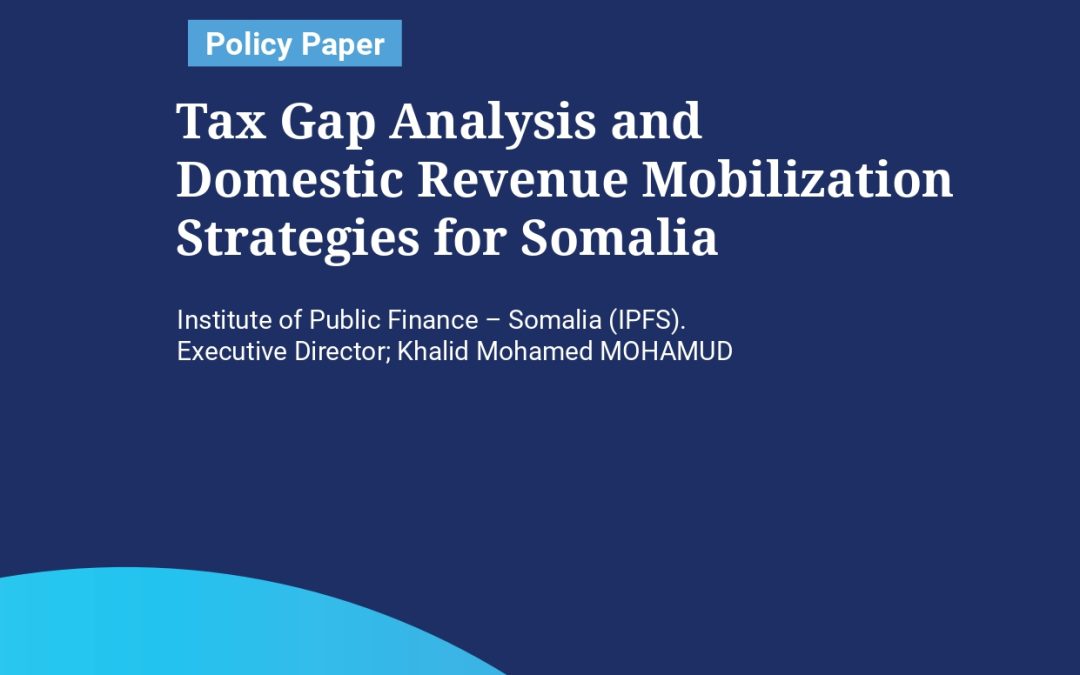
Somalia’s Tax Gap: Why Closing It Matters for the Country’s Future
October 21, 2025·Khalid Mohmed Mohamud
Somalia’s Tax System: Challenges and Revenue Gaps
Somalia’s tax system faces a significant challenge, with a tax-to-GDP ratio of around 3%, one of the lowest globally, highlighting a substantial gap between potential and actual revenues.
- The tax gap—the difference between what should be collected under full compliance and optimal policy, and what is actually collected—was estimated at 34% in 2023.
- Actual revenue reached $329.5 million, while potential revenue exceeded $500 million.
- The largest shortfalls were found in:
- Income tax, with a gap above 60%.
- Sales tax, with a gap above 60%.
- Customs duties, which remain the largest revenue source but face leakage due to administrative fragmentation and evasion.
Key Factors Behind Low Tax Collection
The main causes include:
- The collapse of state institutions after the 1990s weakened tax administration.
- Insecurity and armed groups such as Al-Shabaab have limited government reach and tax enforcement.
- The informal economy dominates many economic activities and reduces the taxable base.
- Weak fiscal arrangements between the federal government and Federal Member States (FMS) reduce coordination.
- Low public trust and limited visible public services discourage voluntary compliance.
- The absence of broad-based taxes such as VAT and excise duties limits domestic revenue growth.
Federal and Regional Revenue Challenges
The federal structure creates additional challenges in revenue collection and distribution.
- Federal Member States such as Puntland and Jubbaland collect and retain their port revenues.
- Inland states remain underfunded due to limited revenue sources.
- Regional disparities continue because of unequal revenue collection capacity.
- Informal taxation and regressive local levies create additional burdens on citizens and businesses.
Reform Strategy
The proposed Domestic Revenue Mobilization (DRM) strategy focuses on:
-
Tax policy reforms
- Enacting a comprehensive VAT law.
- Implementing the new Income Tax Act.
- Introducing excise duties.
- Reducing unnecessary tax exemptions.
-
Tax administration improvements
- Expanding the Integrated Tax Administration System (ITAS).
- Modernizing customs systems.
- Introducing digital tax payment systems through mobile money.
- Using third-party data and analytics to improve compliance.
Customs Revenue-Sharing Framework
Establishing a national customs revenue-sharing framework is critical for national equity and effective state-building.
- Ensuring fair distribution of customs revenues.
- Reducing regional fiscal disparities.
- Improving transparency and accountability.
- Strengthening cooperation between federal and regional authorities.
Building Trust and Improving Compliance
Trust-building is essential for sustainable tax reform.
- Improving public services funded through tax revenues.
- Increasing transparency in government spending.
- Demonstrating visible benefits of taxation.
- Supporting phased formalization of the informal sector.
- Investing in governance and security.
Long-Term Goal for Somalia’s Tax System
The aim is to increase Somalia’s tax-to-GDP ratio from its current 3% toward a long-term goal of 15%.
- Reduce reliance on foreign aid.
- Increase government capacity for service delivery.
- Strengthen state institutions.
- Support sustainable economic development.
- Build a stronger social contract between citizens and the state.
Conclusion
The findings of the Institute of Public Finance – Somalia (IPFS) emphasize that fiscal reform is not merely technical but foundational to peace, development, and legitimacy in fragile states like Somalia.
Strengthening domestic revenue mobilization will help Somalia build a capable state, improve service delivery, increase accountability, and create a sustainable path toward economic independence.