
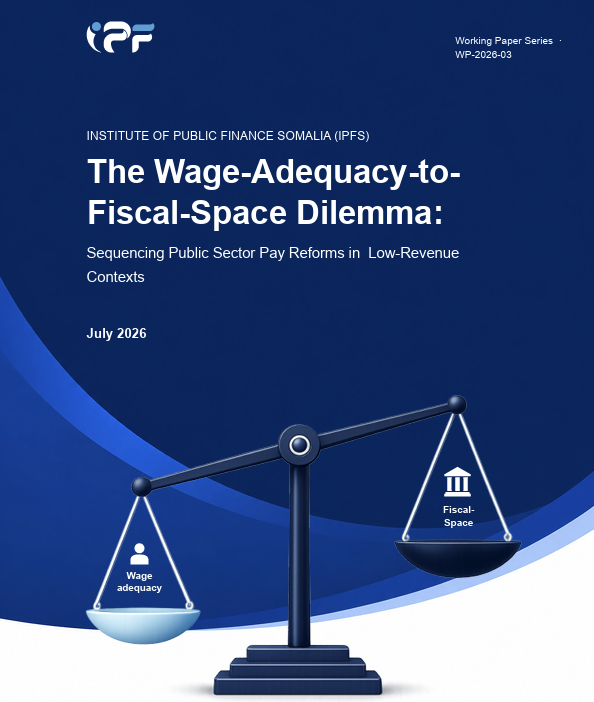
The Wage Adequacy to Fiscal Space Dilemma : Sequencing Public Sector Pay Reforms in Low-Revenue Contexts
July 13, 2026·khalid
Governments in low-revenue and fragile states face a fundamental dilemma in public sector compensation. On the one hand, public wages must be sufficient to meet basic living costs and to attract, retain, and motivate competent personnel while reducing incentives for corruption. On the other hand, the public wage bill cannot be allowed to absorb the limited fiscal resources available, thereby crowding out the operational, maintenance, and capital expenditures necessary for effective service delivery. This paper conceptualizes this tension as the Wage-Adequacy-to-Fiscal-Space Dilemma and argues that it cannot be eliminated but must instead be managed through the careful sequencing of reforms.
Drawing on efficiency-wage theory, living-wage literature, evidence on public–private wage differentials and wage compression, and public-finance theories of fiscal space and wage-bill sustainability, the paper develops an analytical framework for understanding compensation reform under severe fiscal constraints. It further synthesizes comparative evidence from low-revenue and fragile states, including Liberia, Ghana, Afghanistan, the Democratic Republic of Congo, Sierra Leone, South Sudan, and Mali, to identify lessons on reform sequencing and institutional design.
The analysis proposes a five-stage reform sequence: restoring a simple and reliable pay system; establishing payroll integrity and establishment control; embedding wage-bill planning within a medium-term fiscal framework; implementing targeted decompression for scarce and frontline skills; harmonizing pay and grading structures; and only thereafter introducing performance-related pay. Evidence from comparative cases demonstrates that reforms implemented out of sequence—particularly broad pay harmonization or across-the-board salary increases introduced before payroll and fiscal controls are established—often result in fiscal instability, reform reversals, and weakened state capacity.
Using Somalia as the principal case study, the paper examines a context characterized by extremely low domestic revenue mobilization, heavy dependence on external grants, a security-dominated wage bill, and fragmented pay structures. It evaluates Somalia's 2025 Civil Service Grading and Salary Policy against the proposed sequencing framework and argues that sustainable progress toward wage adequacy requires first strengthening payroll integrity, fiscal discipline, and medium-term wage planning. The paper concludes that in low-revenue and fragile states, the sequencing of public sector pay reforms is itself a critical policy instrument, and that getting the order of reform right is essential for expanding fiscal space, improving workforce adequacy, and strengthening state capacity.